
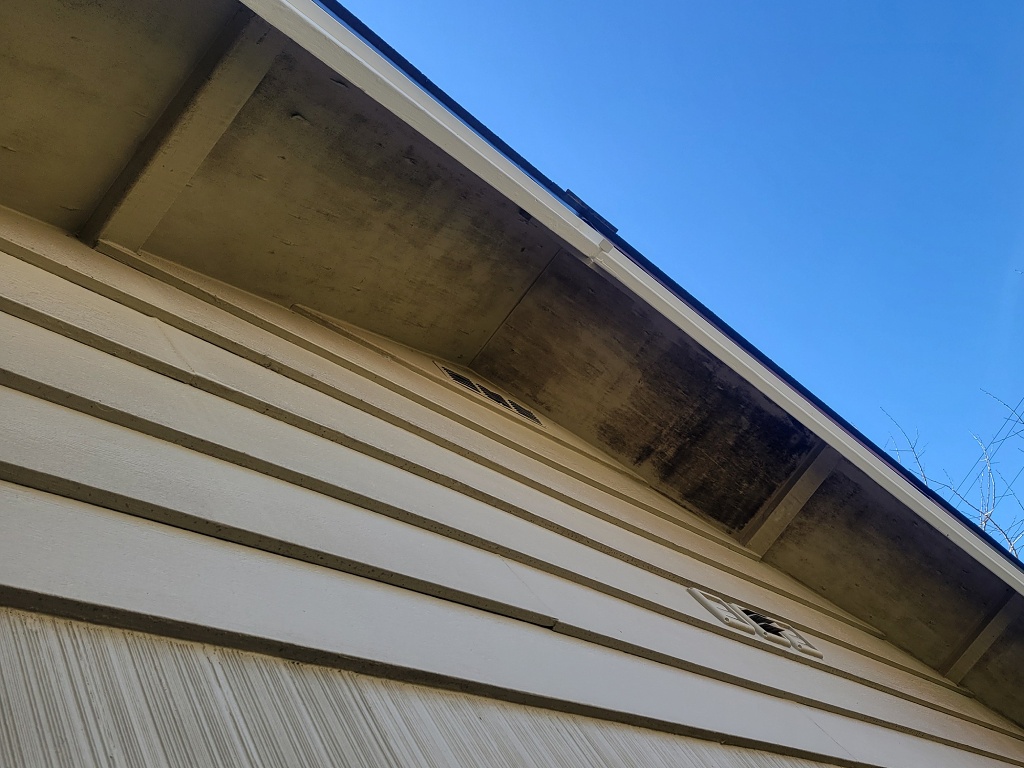
A paint problem or a physics problem—both.
Mold on eaves is common in newer construction, after roof deck replacement, or where exterior maintenance has been limited.
Material preparation and paint quality are contributing factors. In residential construction, primer is rarely applied to raw eave lumber before painting, and paint film thickness is not measured as it is in commercial construction. The siding is typically factory-primed, while the eaves receive only a thin finish coat applied at the same time.
However, paint alone does not explain it.
On clear nights in the Pacific Northwest, roof surfaces undergo radiational cooling. All objects emit infrared energy. With cloud cover, some of that energy reflects back toward the surface. On clear nights, more heat radiates outward, allowing the roof surface and decking to cool — often 10–15°F below ambient air temperature.
When humid air contacts a surface below the dew point, condensation forms, similar to moisture forming on a glass of ice water. The underside of the roof deck near the eaves can remain damp longer because it receives less direct solar warming. Damp surfaces attract dust, a food source for fungi.
Will the mold rot the roof sheathing?
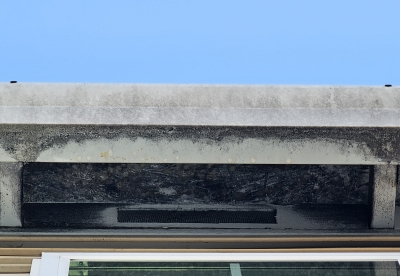 Surface molds feed on organic dust and biofilm present on damp surfaces. They do not consume structural wood. In most cases, this is a surface condition. Long-term moisture combined with coating failure can contribute to wood deterioration if maintenance is neglected.
Does it migrate into the attic?
Typically no. Attic mold is usually a separate building-performance issue in which radiational cooling and moisture conditions within the attic contribute.
What can be done?
Clean the affected areas. Apply a stain-blocking or anti-fungal primer. Recoat with a quality exterior acrylic paint in a satin or semi-gloss sheen, which resists biofilm adhesion better than flat finishes. Periodic washing as part of routine maintenance helps manage recurrence.
Geek note: This same radiational cooling effect is being studied as a passive method to reduce building cooling loads.
A related article: Attic Mold